What this routine measures
This is a compact way to practise two observable outcomes at home: whether a gently rolled ball passes a small checkpoint and whether it stops inside a chosen zone. It is not a test of putting skill, a putting lesson, or a simulation of green speed. Carpet, practice mats and real greens roll differently, and even two directions on the same carpet may behave differently. Use the counts to describe one setup consistently, not to promise or predict improvement. The routine needs a putter, an existing real golf ball, a ruler, and small paper markers. It takes about ten minutes when the area is ready, but allow more time to set up safely.
Make a safe, repeatable lane
Choose a flat, low-pile carpet or a practice mat you already own. Clear the full lane and the space beyond it of people, pets, glass, cables and anything the ball could hit or knock over. Leave a clear buffer beyond the far stopping zone. Move rugs or furniture only if doing so is safe; do not create a trip edge or put markers where someone may step on them. Make only gentle putting strokes—no full swings, airborne practice balls or forceful rolls. Use the ruler to measure, then remove it from the ball's path. Keep paper markers flat or just outside the lane so they cannot snag or deflect the ball. If you cannot keep the lane and runout clear, skip the rolling tasks.
Check the surface and troubleshoot calmly
Before scoring either block, make three gentle rolls along the same line and watch for repeatable drift, snagging or an obvious change in roll. This is a fairness check for the lane, not a diagnosis of your stroke or the carpet. If the ball repeatedly veers or catches, check that the start and checkpoint are aligned, the markers are clear of the path, and the lane is not crossed by a seam or uneven patch. You can try another safe direction on the same suitable surface, but record the new direction as a different setup. If the carpet is too rough for a consistent roll, skip the pace task and record it as unscorable—not zero. You can still use the measurements to practise setting up the lane without assigning a score.
Set up the start-line checkpoint
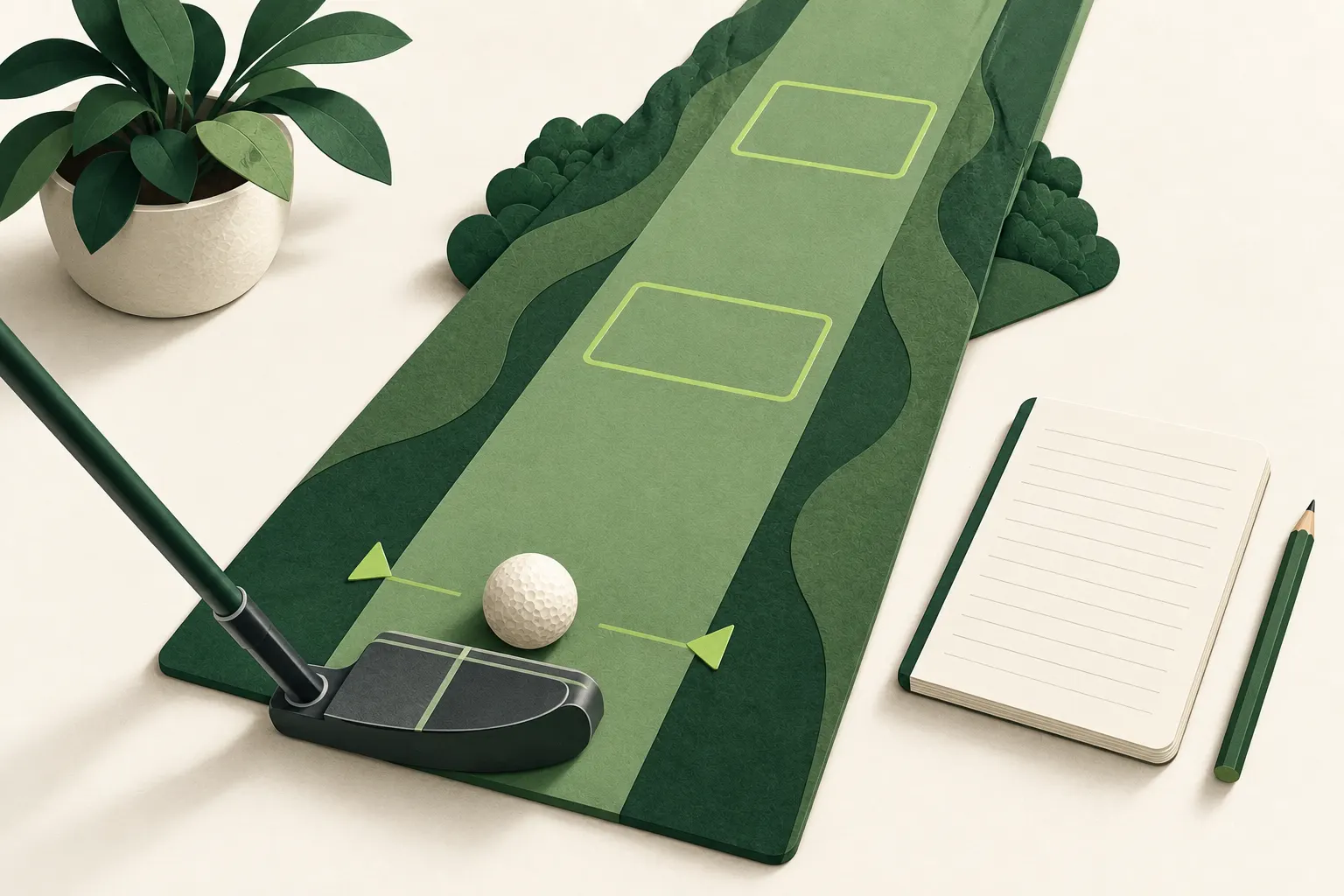
Mark the ball's starting point with a small paper marker beside the lane, not underneath the ball. Measure 30 centimetres straight ahead from the ball's centre. At that checkpoint, use two paper markers to show a gap whose inside edges are one ball diameter plus 20 millimetres apart. The extra space leaves a small margin on each side; it is a visible target, not a claim about ideal alignment. Remove the ruler before putting. From the same start mark, roll toward the gap with enough gentle pace to reach it. A clear pass means the whole ball travels through the gap without touching either inside edge. A touch, a side miss or a ball that stops short is not a clear.
Read upward from the ball. These are two separate tasks, not a putt through all targets.
Clear runout beyond the far zone
Far stopping zone
Centre: 1.5 m from ball start
20 cm wide × 30 cm deep
Near stopping zone
Centre: 1 m from ball start
20 cm wide × 30 cm deep
Line checkpoint
30 cm from ball start
Inside gap: ball diameter + 20 mm
Remove it for the pace block.
● Ball start — 0 m
Keep the start mark beside the ball.
Use paper outside the rolling path. For pace, the ball’s centre inside or on the target boundary counts; for line, the whole ball must clear the checkpoint without touching its edges. Shorter rooms need distinct closer zones and clear runout; log the actual distances.
Run the line block
First make two unscored rolls to learn how this surface responds. Then make ten scored rolls, one at a time, returning the ball to the same start mark and resetting any shifted paper. Record Clear when the ball passes the checkpoint as defined above. For a ball that reaches the checkpoint but misses, record Left or Right according to the side of the gap it passes. If it stops before reaching the checkpoint, count it as not clear and add a short note; do not guess a left or right direction. Keep all ten attempts in the record, including awkward ones. The score is the number of clear passes out of ten. These labels describe where the ball went in this setup; a miss by itself does not identify face angle, stroke path or another cause.
Mark two pace zones
Remove the checkpoint markers before the pace block so they cannot affect the roll. Keep the same ball start mark and lane. Mark two rectangular stopping zones with paper just outside their edges: each zone is 20 centimetres wide across the lane and 30 centimetres deep along it. Centre the first zone 1 metre from the start and the second 1.5 metres from the start, measuring to each zone's centre. Keep both on the same intended line and leave clear runout beyond the far zone. The dimensions are convenient practice targets, not a standard or calibration. If your room is shorter, move both zone centres closer and write down the actual distances so you can recreate that layout. Keep the zones distinct and do not shrink the clear runout to fit a zone against a wall or furniture.
Run and score the pace block
Make two unscored rolls to become familiar with the zones, then take ten scored putts, alternating near and far targets for five attempts at each. Reset the ball to the start mark each time. A putt counts inside when the centre of the ball stops within the assigned rectangle or on its boundary line. Give every miss one primary label: if the centre is outside the zone's width, record Side, even if the ball is also short or long; otherwise record Short if it stops before the near edge, or Long if it travels past the far edge. The pace result is the total inside out of ten; keep near and far counts visible too. Do not combine this with the line score into a total rating.
Keep a useful log
Write down the date, surface or mat, direction of roll, ball, start-mark position, checkpoint gap, zone-centre distances, and any unusual drift or snag. Then record the line result as clear passes out of ten, with Left, Right and short notes; record the pace result separately as inside out of ten, plus near and far counts and miss labels. A dash or unscorable note is more honest than filling in a result the surface could not support. Use the blank scorecard below for ten line attempts followed by ten pace attempts; each row holds one attempt from each separate block.
Blank 20-attempt scorecard
Copy or print this table. Complete all ten line putts first, then all ten pace putts. Each row records two separate attempts. The three surface-check rolls and two familiarity rolls per task are unscored.
Line codes: C = clear; L/R = left/right; T = edge touch; S = stopped short. Only C counts. If an edge touch also goes left/right, write T and add a note.
Pace codes: I = inside; X = outside the width; S = short; L = long. Check X first; otherwise use S or L. Only I counts.
| Try | Line code | Pace target | Pace code |
|---|---|---|---|
| 1 | ____ | Near | ____ |
| 2 | ____ | Far | ____ |
| 3 | ____ | Near | ____ |
| 4 | ____ | Far | ____ |
| 5 | ____ | Near | ____ |
| 6 | ____ | Far | ____ |
| 7 | ____ | Near | ____ |
| 8 | ____ | Far | ____ |
| 9 | ____ | Near | ____ |
| 10 | ____ | Far | ____ |
Line clear: ____ /10. Pace inside: ____ /10 (near ____ /5; far ____ /5). Do not add these into a total rating.
Setup record: Date ____; surface/direction ____; ball ____; start mark ____; checkpoint inside gap ____; near centre ____; far centre ____; zone width/depth ____; drift/snags ____; notes ____.
If the surface cannot support the task, write “unscorable” instead of inventing a score. Keep the blank spaces blank until you practise.
Compare sessions without moving the goalposts
For a fair comparison, keep the surface, direction, ball, start mark and dimensions the same. If you change the surface, rotate the lane, move the start or alter the checkpoint or zones, treat it as a new baseline rather than a direct before-and-after comparison. Finish and log a block before changing one setup variable; that makes it easier to see what changed without turning a short practice session into a search for a favourable score. Do not restart or omit a miss to make the count look better. A consistent indoor score can describe repeated rolls on that lane, but it cannot calibrate grass, slope, moisture or the speed of a course green. Recheck pace on the course's practice green before playing.
Buy only if the setup needs it
No purchase is needed when your existing surface rolls consistently and the lane is safe. If the floor or storage is the limiting factor, our putting-mat footprint and storage guide explains what to measure before buying. A mat is not a guarantee of course-green pace.
If you want a visual reference for your setup rather than stopping-distance feedback, see the putting-mirror feature guide. Skip the extra tool if the paper checkpoint already meets your needs; a mirror cannot diagnose a miss from this scorecard. Those buying guides disclose their affiliate links; this routine has no direct retailer links or product cards.
Can carpet tell me how fast a real green is?
No. Carpet and mats have different rolling characteristics from grass greens. This routine records outcomes on the named indoor setup only; it is not a green-speed measurement.
What if the room is not long enough for the 1.5-metre target?
Shorten both zone distances only if the zones remain distinct and you can still leave a clear runout beyond the far zone. Record the new centre distances. If you cannot keep the lane and runout safe, skip the pace block.
Should I count a ball that touches a checkpoint marker as clear?
No. A clear requires the whole ball to pass through the gap without touching either inside edge. Count a touch as not clear.
What if a putt stops before the start-line checkpoint?
It is not a clear. Record it as a miss with a short note, and do not assign Left or Right unless the ball actually reaches the checkpoint and passes on one side.
Does a left or right miss prove my putter face was aimed that way?
No. The result can reflect the setup or surface as well as the roll. The scorecard is descriptive feedback, not a diagnosis of face angle or technique.
Can I change the targets between sessions?
Yes, but log the new dimensions and treat the changed layout as a new baseline. Keep the setup fixed when comparing results across sessions.