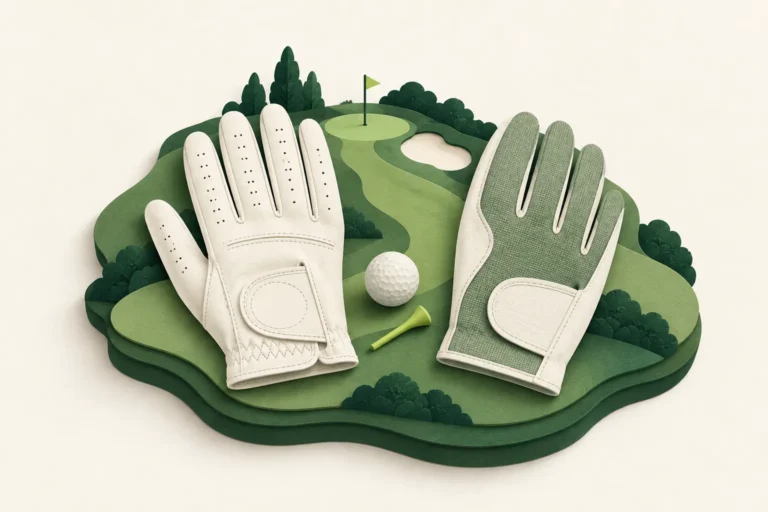
Start with the hand you will wear it on
Golf glove listings describe the hand covered by the glove, not simply whether you are a right- or left-handed person. In a conventional one-glove setup, a right-handed swing normally uses a left-hand glove and a left-handed swing normally uses a right-hand glove. Check the product selector or package before looking at size: a well-measured glove for the wrong hand is still the wrong glove.
For a normal single-glove purchase, write down “left” or “right” before opening the size chart. If you use a pair, confirm that the listing is a matched pair and check its hand arrangement.
Measure the same way the manufacturer does
Do not start with a size letter from another brand. The useful measurement is the one the chosen maker actually uses. FootJoy's fitting guide asks for middle-finger length and hand circumference around the first knuckle, excluding the thumb. Use its chart and measuring aid as a FootJoy-specific method; another manufacturer may use a different chart or offer different cuts.
Record both values and match them to the exact glove family and hand option. If the result falls between FootJoy sizes, its guide says to try the smaller size first and then try the glove on. That is a FootJoy recommendation, not a universal conversion rule. A Titleist medium and a FootJoy medium should not be treated as interchangeable without each maker's chart.
Regular versus cadet: compare proportions, not labels
Regular and cadet are cuts, not a worldwide sizing standard. FootJoy defines Regular as standard palm-and-finger proportions and Cadet as a wider palm with shorter fingers. The practical question is whether your palm and fingers need different proportions, not whether one label sounds smaller.
Check cadet when a regular glove leaves extra material at the fingertips but sizing down would make the closure too short or tight. FootJoy also suggests it when fingers swell during a round. If a regular glove passes the fit checks, there is no reason to switch just because cadet exists. Confirm that the chosen model offers the cut and hand you need.
Use this fit checklist after measuring
Measurements narrow the choice; trying the glove on makes the decision. Use this short checklist:
- Palm: the material sits close without bunching or a loose pocket.
- Fingers: each fingertip reaches the end without a fold of spare material. Extra material is a reason to check the smaller size or a cadet cut, not to assume every glove runs large.
- Movement: close and open your hand. The glove should not restrict a natural grip or need repeated pulling into place.
- Closure: fasten it securely but leave adjustment room; FootJoy illustrates a tab that does not run completely across the back of the hand.
- Hand and cut: re-read the label. “Regular left” and “cadet left” are not the same shape, and neither is a right-hand option.
If the fit is good but the glove feels uncomfortable, re-check the measurement method, model, material instructions and return terms rather than forcing a break-in.
The no-purchase decision is part of the guide
Keep your current glove when it is for the correct hand, stays close across the palm and fingers, has no fingertip slack, and closes without an awkwardly tight tab. A new size letter or cadet label is not automatically an improvement. Replace it when fit, hand choice or condition no longer works, then measure again instead of guessing from memory.
Once fit is settled, see the separate Cabretta Leather Golf Gloves: When Are They Worth Paying For? guide if material choice is the remaining question. For wet rounds, see Golf Rain Gloves: Compare Wet-Weather Grip, Fit and Care for pair, wet-weather and care decisions. Neither link changes the sizing rule: choose the hand and maker's chart first.
Is a cadet glove just a smaller regular glove?
No. Cadet is a different proportion: FootJoy describes it as a wider palm with shorter fingers, while Regular has standard palm-and-finger proportions. A cadet glove can solve extra fingertip material without forcing the entire glove smaller, but the exact chart and available cuts belong to the chosen manufacturer.
Which hand should a right-handed golfer buy?
For a conventional one-glove setup, a right-handed golfer usually wears a glove on the left hand; a left-handed golfer usually wears one on the right. Verify the listing's hand label as the hand covered by the glove, especially when a product offers Regular Left, Cadet Left and Regular Right options.
What should I do when my measurements fall between sizes?
Follow the selected manufacturer's chart and try the glove on if possible. FootJoy advises trying the smaller size first when between sizes, then checking for snug fingers, a close palm and usable closure adjustment. Do not transfer that result to another brand as a guaranteed equivalent; recheck that brand's own chart and cut.